Value vs Hype: How to Create Useful Financial Content

Investing content competes in an environment built for speed: fast takes, bold predictions, and instant reactions. But attention is not the same as value. Every financial creator faces a recurring choice: optimize for clicks and short-term engagement or invest a little more effort to help readers think more clearly and make better decisions.
This article introduces a simple clarity–value framework for evaluating financial content. We define the difference between hype, noise, and usefulness, walk through concrete examples, and end with a practical checklist you can use when planning posts.
This article is based on my experience creating financial content, combined with widely observed best practices in investing communication and building trust with the audience.
The Quadrant: Clarity vs Value
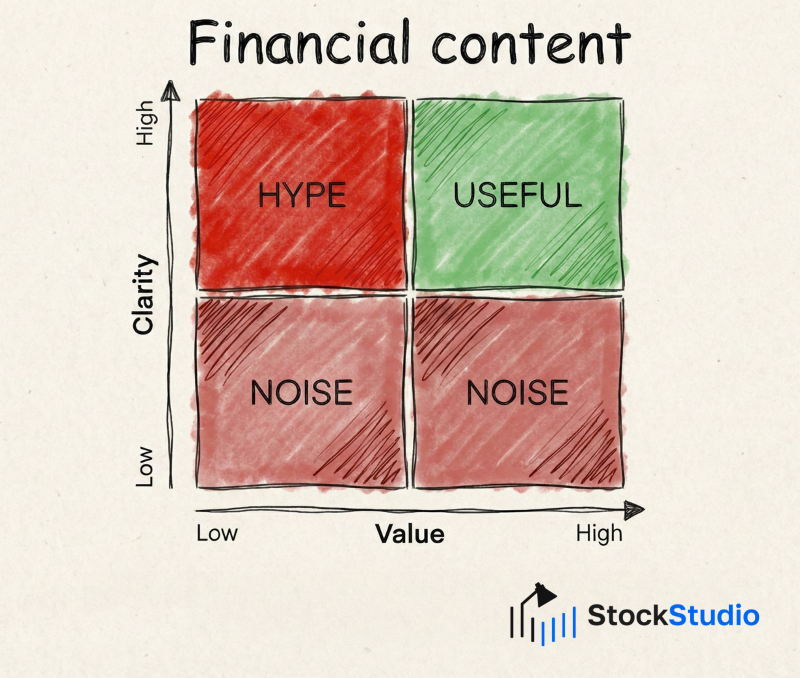
The Four Quadrants of Financial Content
• Useful (high clarity, high value): Clear ideas that teach, explain reasoning, or provide actionable steps. This is the sweet spot.
• Hype (high clarity, low value): Easy-to-read posts that draw attention but add little substantive insight (for example, bold price predictions without reason).
• Noise 1 (low clarity, low value): Confusing or shallow content that neither teaches nor convinces.
• Noise 2 (low clarity, high value): Valuable content presented poorly. With small edits, these posts can be upgraded into the Useful quadrant.
Here, clarity refers to how easy your message is to understand, and value refers to what the reader walks away with, e.g., educational takeaways.
The goal for responsible creators is to move more of their output into the Useful quadrant: short, readable posts that bring value to the reader.
What is Hype? What is Noise?
Hype is clarity without substance. It's bold, punchy, and clickable: price calls, sensational headlines, or hot takes presented with confidence but lacking reasoning. Hype can spark engagement quickly, but it rarely helps readers learn. Examples include posts that say "$TSLA to $2,000" or "This stock will 10x" without valuation, timeline, or risk discussion.
Noise is the opposite problem. It neither educates nor communicates well. Noise can be rambling threads, screenshots with no context, contradictory claims, or posts that rely on jargon without explanation. Noise buries signal and erodes trust.
Both hype and noise harm the audience. Hype encourages action without understanding; noise wastes attention and creates confusion.
What High-Value Content Looks Like (With Examples)
Valuable content puts the reader in a better position to make a decision or seek out information about a subject. Here are examples of formats that deliver value:
- Short explainers: A 2–4 line breakdown of a concept (e.g., "How to read a balance sheet in 3 steps").
- Reasoning posts: Share a trade or idea plus the why (valuation, catalyst, timeframe, risk). Example: "Bought ABC at $12. Why: P/E below peers, 18% revenue CAGR, management guidance revised up; risk: high debt that could amplify downside."
- Mini-frameworks: Reusable mental models like a checklist for screening dividend stocks or a 3-step model for assessing competitive advantage.
- Comparisons: Show tradeoffs (e.g., growth vs value metrics) and when each approach fits a portfolio.
- Tool or workflow demos: How you use a valuation template or a checklist (screenshot + 3 bullet takeaways).
- Counterarguments and risks: Show the bullish case and the bearish case to invite critical thinking.
If you want more granular examples and post templates, see the eToro post ideas guide I put together for extra inspiration.
High Clarity vs Low Clarity: A Concrete Comparison
High clarity doesn't mean dumbing things down; it means expressing insights in a way that respects the reader's time and attention.
Someone can have amazing knowledge, but if they can't explain it clearly, it becomes noise.
Low Clarity Version (Jargon & Complexity)
"The company is leveraging synergistic adjacencies across its vertically integrated operational paradigm to optimize margin accretion as macro conditions normalize. Investor positioning remains constructive due to anticipated liquidity infusions and favorable policy tailwinds."
High Clarity Version (Simple & Specific)
"The company has cut manufacturing costs by 8% by producing more components in-house. If inflation continues to ease, margins should improve further. Investors are positive because the company is expected to receive new government contracts later this year."
Same insight. One is noise. One is useful.
How Useful Content Elevates Decision-Making
Combining clarity and value: when you clearly explain your assumptions and the data behind them, you:
- Invite smarter discussion and better feedback.
- Reduce misinterpretation and the spread of misinformation.
- Help newer investors form their own frameworks instead of copying actions.
- Build credibility over time (people remember helpful posts more than flashy ones).
These benefits compound. Consistent exposure to clear, educational content strengthens recall and trust more effectively than sporadic bursts of attention.
Real-World Evidence
This dynamic is clearly evident in practice. Creators like Ben Felix, Aswath Damodaran, or Morgan Housel rarely rely on sensational predictions, yet their consistent focus on reasoning, risks, and explanation has earned them long-term trust and influence.
Practical Checklist for Creating Useful Financial Posts
Use this checklist before you publish:
- 1.What is the single point? Can you summarize it in one clear sentence? If not, rewrite.
- 2.Why does it matter? Provide the immediate reason and one longer-term implication.
- 3.Show the evidence. Include a metric, a link, a chart, or a short example.
- 4.State the risk. What could go wrong? Give at least one counterargument.
- 5.Actionability. Is there a clear takeaway or question for the reader?
- 6.Brevity check. Can an unfamiliar reader understand this in <30 seconds?
If any of the answers are weak, iterate before posting.
Tools and Workflow Tips for Clearer Posts
- Keep a running notes file for every idea: a bullet list of the core point, 1–2 metrics, and a risk. When you post, you already have structure.
- Use screenshots sparingly, always annotate them with a short takeaway.
- If you use a generative tool to help structure content, treat it as an editor. Verify everything, add your own evidence, and state assumptions clearly.
Building Better Tools
I'm building a tool that helps creators structure financial posts with this exact framework, not to flood feeds with content, but to help people who know investing communicate more effectively.
Conclusion and Next Steps
Consistently producing clear, valuable content may take slightly more effort than publishing quick takes, but the long-term payoff is far greater. It sharpens your own thinking, attracts a more serious audience, and builds a reputation rooted in trust rather than attention spikes.
Use the clarity–value quadrant as a filter, the checklist as a habit, and your posts will naturally migrate toward the "Useful" category, the one that truly helps people.
About StockStudio
We're building the ultimate toolkit for financial content creators. From automated post generation to post scheduling, StockStudio helps you create professional content that grows your influence.